Pages

Wednesday, June 4, 2014

BQ #7: Unit V- Derivatives and the Area Problem

1. Explain in detail where the formula for the difference quotient comes from now that you know! Include all appropriate terminology (secant line, tangent line, h/delta x, etc).
- Well to begin, the difference quotient is as follows, below.
http://images.tutorvista.com/cms/images/39/difference-quotient-formula.png
The formula helps when you need to find the slope of a tangent line at a given function. This formula was derived from the visual of a graph.
http://www.teacherschoice.com.au/images/derivative_secant_1.gif


http://www.zweigmedia.com/ThirdEdSite/summarypic/cs3_1.gif
The picture on the left goes to show the visual and we see a secant line(a lone on the graph that touches twice) that in the x-values we have x and x+h with the distance of h between them. For the first y-value we have f(x) and that makes logical sense because the shift to the right was x and the shift up was call f of x. So then the second point which is x+h has a y-value of f(x+h). 


http://webpages.charter.net/mwhitneyshhs/calculus/tangent_lines/tngt-slope-eq001.jpg


Then we would want to find the slope of those two points which is (x,f(x)) and (x+h,f(x+h)) so that we would be able to find the distance between them. So we would then have to use the slope formula which is the following picture to the left. So we would take our ordered pairs and we would plug them into this formula to get, f(x+h)-f(x)/ x+h-x and is you simply it we would be left with f(x+h)-f(x)/h which matches the original formula that we have.


The video below is great help in putting what I said to the test. It would help tremendously to view it to see it worked out.

 https://www.youtube.com/watch?v=iMaJDAV7as0

Monday, May 19, 2014

BQ#6 Unit U Concepts 1-8

1. What is continuity? What is discontinuity?
http://intmstat.com/different
iation/x3.gif
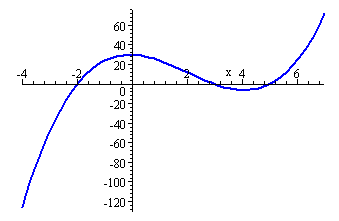
-A continuity is a continuous function that has no breaks, no jumps, no holes, it is also predictable and it is able to be draw without lifting up a pencil from the paper. ** Just incase you were not aware, continuous means if the value and the limit are same. The following picture to the right show a continuos function, Note: That is a just a nice smooth line and has no interruptions such as break,jumps, or holes.

http://www.zweigmedia.com/RealWorld/calctopi
c1/pics3/pic1.gif


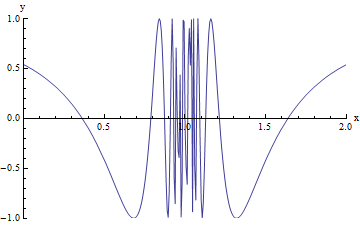
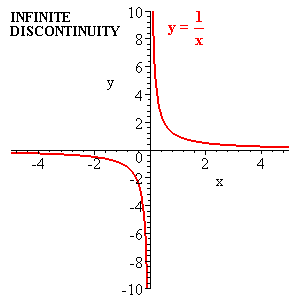
-A discontinuity would obviously be the opposite of a continuous function and it WOULD include breaks, jumps and holes, like the picture of the right. There are four different types of discontinues that consist of two different families such as removable and non-removable discontinuities such as point discontinuity, that IS considered a removable discontinuity because it there was still and intended height that the function had planned. The next three are considered non-removable: jump, oscillating(wiggly), and infinite. Only for the three non-removeable discontinuity, that there limits can NOT be reached because there are different if not not definite limit.** Check question 2 for further information.


http://ocw.mit.edu/ans
7870/18/18.013a/textbook/Ma
thML/chapter06/images/infinite.gif
Oscillating Discon.
http://www.cwladis.com/math
301/lectu
re%20images/infiniteoscillatio
ndiscontinuityat1.gif


http://ocw.mit.edu/ans7870/18/18.013a/tex
tbook/MathML/chapter06/images/infinite.gif


http://fitnessandfrozengrapes.com/wp/
wp-content/uploads/2012/10
/the-limit-does-not-exist-mean-girls.jpg
2. What is a limit? When does a limit exist? What is the difference between limit and value?
-A limit is the intended height of a function. The only time that the limit exist is when the left and the right direction actually meet  at a definite spot. This statement can be seen at point discontinuity (smooth line)  because the left and the right side meet which means that the limit and the value are the same. The value is the actual height that a function is able to reach. For a Infinite Discon. there is no limit because of the presence of a vertical asymptote which then leads to unbounded behavior. For a Jump Discon. there is no limit because of different Left and Right. For Oscillating Discon. the limit does not exist because there is no definite height reached.

3. How do we evaluate limits numerically, graphically, and algebraically?

http://apcalc-kati.weebly.com/uploads/8/6/8/1/8681919/3276816.png
-Numerically:
To evaluate a limit numerically, you take your x-value and you add one tenth to the right and subtract one tenth to the left. For example: if you take a look at the picture to the left, you added 9's to indicate your closeness  to the number in the center, which in this case is 1. On the right side you add 0's to indicate the closeness as well. Afterwards you substitute back in your x-values into the equation to get your y-values and lets say that the number to the left are 6.9,6.99,6.99 and on the right its 7.001,7.01,7.1 then we know that the middle number will be 7 because of where the numbers are approaching.
http://1.bp.blogspot.com/_X1HiqovpZd0/TJidWbCJZyI/AA
AAAAAAAmU/L8LU7ZDBHTo/s160
0/LimitsGraphically002.jpg

-Graphically:
To evaluate limits graphically, you take your index fingers and place on the left and one on the right, and get closer and closer to the x-value that the limit is being asked for. If you fingers actually meet then there IS a limit and if they do NOT then there is not limit because of different left and right, oscillating or unbounded behavior.


-Algebraically:
To evaluate limits algebraically, we always try the substitution method first. The reason being is because it is the easiest method because it can sometimes give you the answer with only having preformed a few simple steps. While using the substitution method we can get a numerical answer like a -5 or 2 or 4. We can also get ) divided by a number and that equals zero. We can also get a number over 0 and that leads to undefined which means that the limit does not exist. We can also get 0 over 0 and that is indeterminate form and we then have to use two other methods, either dividing/factoring or the conjugate. For the dividing/factoring method we would used when we are trying to factor the numerator and the denominator to cancel something out. For more information click here. If the dividing/factoring method does not work, then we would result to the conjugate method which would basically cause us to multiply the fraction by the conjugate of the denominator or numerator, it depends where the radical in the expression is.  We would then foil and cancel out the terms that are similar and what is left remaining we would multiply what ever is left and then use direct substitution to finish it off.

Monday, April 21, 2014

BQ #5: Unit T Concepts 1-3

Why do sine and cosine NOT have asymptotes, but the other four trig graphs do? Use unit circle ratios to explain.

http://htmartin.myweb.uga.edu/6190/resources/unitcircletrig.gif
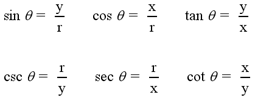
This can be an easy questions to answer if you take a glance at the picture above. *Just make note that the '1' that you see in the picture will be referred to as 'r'. To start off m explanation, r =1 and that's that. The reason why sine and cosine do NOT have asymptotes is because of the r that they have as the denominator. 
Like the picture shows already for sine, the ratio is y over r which is basically y. For cosine the ratio if x over 1 which is basically x. With these ratios for cosine and sine we are guaranteed an answer.
However, for all the other functions, we are not. if we have 1 over 0, now we have undefined which is an asymptote For all the other ratios we will get undefined because if you  have 0 over r (1) for sine and cosine then you will have 0 and that is fine. Having a 0 in the denominator we know that it will be undefined.

Friday, April 18, 2014

BQ#3 – Unit T Concepts 1-3

-How do the graphs of sine and cosine relate to each of the others?  Emphasize asymptotes in your response.

a) Tangent


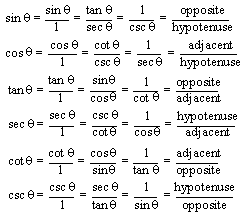
Tangent is related to sine and cosine because the ratio for tangent is sin over cos. Tan and sin and cos have a relationship where if sin or cos is negative then so will be tan. You can reference my BQ 4 for more information here. In quadrant 1 all of the trig functions are positive. In the 2nd quadrant only sine and cosecant are positive but since cosine is negative, so will tangent. This continues to the rest of the quadrants, so basically to make it simpler, if either sine or cosine are negative then so will tangent.

b) Cotangent  


Sine and Cosine relate to Cotangent basically in the same way that tan does. The ratio for cotangent is cos over sin which then basically means that in order to have asymptotes sin has to equal zero. Sine equals zero at 0 or 2pi. From then on the asymptotes repeat forever and the graph will never be able to cross them. 


c) Secant


Secant can be related back to sine and cosine. The ratio for sec is 1 over cos so what that implies is that cos has to equal zero. Cosine can equal zero when it is at 90 degrees or 270 degrees. If that were to be that case, there would be asymptotes. The secant and cosine relate  because the reciprocal of secant is 1 over cosine which also leads to having cosine equal zero. In a cosine graph, the numbers -1 and 1 show up and if you take a look at the graph, -1 and 1 also show up.


d) Cosecant
  The graph above demonstrates a co-secant possibly relate to sine? Well if you remember something sine you know that it is positive in quadrant 1 and 2. The reciprocal ratio for co-secant is 1 over sine. Something that they have in common is that co-secant touches the mountain tops and the valleys of a sine graph.

Thursday, April 17, 2014

BQ#4 – Unit T Concept 3

http://etc.usf.edu/clipart/36700/36731/tancotan_36731_lg.gif

http://www.afralisp.net/reference/images/sin-cos06.gif


Why is a "normal" tangent graph uphill, but a "normal" tangent graph downhill? Use unit circle ratios to explain. 
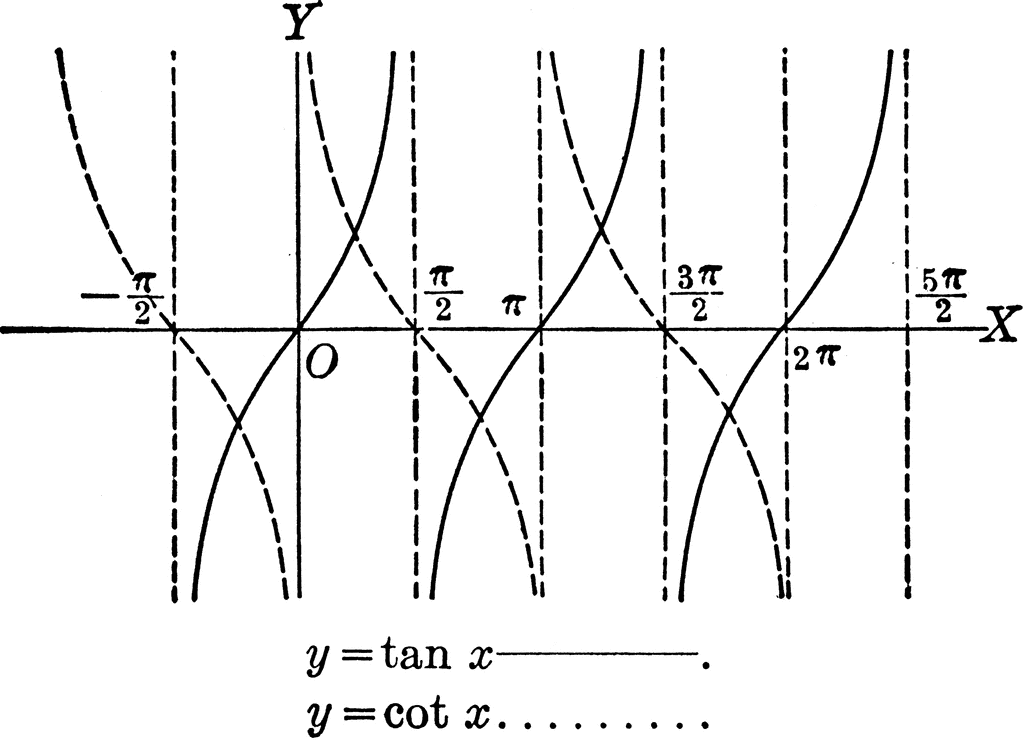
 There are two types of tangent graph, your normal tangent graph that has a ratio of y over x, and your other graph is your cotangent graph that has a ratio of x over y. The only difference why one graph goes up and the other one goes downhill has to do with there asymptotes. So with that being said, you know that for a tangent graph you will have an asymptote where cosine = 0. If you take a look above, you'll see that the ratio for tan is sin over cos. So it makes since to say that a tangent graph will have asymptotes when cos is 0 because cos is in the denominator and if you have a 0 in the denominator you will get 'undefined'. For a cotangent graph it is basically the same thing. The ratio for a cotangent graph is cos over sin and in this case sin has to equal 0

Wednesday, April 16, 2014

BQ#2 – Unit T Concept Intro

*How do the trig graphs relate to the Unit Circle?
 Trigonometric graphs (dealing with sin,cos,tan, and their inverses) can easily be related to the Unit Circle. The graph actually in it of itself has trig graphs.
http://www.regentsprep.org/Regents/math/algtrig/ATT5/unitcirclegraphs.htm


http://www.regentsprep.org/Regents/math/algtrig/ATT5/unitcirclegraphs.htm
The following picture actually demonstrate  how a unit circle were to look if it were to be unwind. The way to know when a graph goes up or continues to go up or down it, it ties back with the saying "All Students Take Calc." For example, if we are dealing with sin, we know that sin is positive in the first and second quadrant, so then, like shown on the top left picture, the lines in quadrant 1 and 2 are positive and in 3 and 4, they are negative. 


Period? - Why is the period for sine and cosine 2pi, whereas the period for tangent and cotangent is pi?  
 If you take a look at the picture shown on the left, if will help with understanding and my explanation to why the period for sine and cosine is 2pi when for tan and cot it is just pi. 
Well if you see the pattern of sin, ++--, and the pattern of cos, +-+-, you notice that that is the end of the pattern. So you know that ++- -or +-+- is the completion of 1 full round around  the unit circle which is also equivalent to 2pi, a whole round around the unit circle. However, with tan and cot it's different. Since there pattern is +-+- their full pattern basically ends at +- because then it starts over with +- again. With that being said, tan and cot only have periods of pi because there complete round, finishes at the pi mark and does not have to go around the unit circle completely.

Amplitude? – How does the fact that sine and cosine have amplitudes of one (and the other trig functions don’t have amplitudes) relate to what we know about the Unit Circle?
Amplitude determines how high a graph might go and how low it will go. A note to remember is that the same high it may have to go up, it will also be the same as that. So for example, is a graph an amplitude of 2 then the highest point on the graph will be 2 and the lowest point will be -2. However, for sine and cosine there amplitude will be 1 and -1 because the graph can only go up one and down one.

Tuesday, April 1, 2014

Reflection#1: Unit Q: Verifying Trig Identities

Hello fellow math analysis Students,
Encountering Unit Q, which deals with ratio identities, reciprocal identities, and Pythagorean identities, might seem overwhelming, I know that for me it did; but if you're like me, fear no more because dealing with this Unit does not have to be scary. I will answer question in hope that this will help you, so enjoy!


What does it actually mean to verify a trig identity?

-To actually "verify a trig identity" it basically means to demonstrate that both side of an equation given to you is equal to one another. The really cool thing about this Unit, is that there is not an actual method that you must preform in order to get it right, as compared to different Unit, where you must do certain steps in a certain order, well anyways, I do not want to get off on a tangent, get it? :) Well just keep in mind that you there are various steps you can take to verify a trig identity.

What tips and tricks have you found helpful?
- My tips and tricks to you is always try to reduce the larger side first and if that is not applicable then just try to have SIN and COS that always works. There are times, that having all the trig functions to one side can help. Another helpful hint is to remember that *Pythagorean Identities CANNOT be "powered up/and or down". I would also advise to make smart choices when using the ratio, reciprocal, and Pythagorean identities.

Explain your thought process and steps you take in verifying a trig identity.  Do not use a specific example, but speak in general terms of what you would do no matter what they give you.
 - My thought process and steps that I take to verify a trig identity is to try to get everything to SIN and COS first. I then try to find if any ratio, reciprocal, and Pythagorean identities would work to help me verify the trig identity. I would try to see if conjugating or finding the LCD or foiling anything would help me. 

Wednesday, March 26, 2014

SP#7: Unit Q Concept 2: Finding All Trig Function Values Using Identities

This SP8 was made in collaboration with Melissa A. This SP8 was made in collaboration with here. 

Wednesday, March 19, 2014

I/D3: Unit Q: Concept 1 - Pythagorean Identities

 
http://2.bp.blogspot.com/-C8eIx6cuzZ8/UT1Fd8RhEOI/AAAAAAAAAKc/oh0fvEjF1s4/s640/Identity+Table.png


1. Where does where sin2x+cos2x=1 come from to begin with (think Unit Circle!). You should be referring to Unit Circle ratios and the Pythagorean Theorem in your explanation.
   -  To start off, What is an identity? Well an identity is a proven fact or formula, just  like the Pythagorean Theorem. Pythagorean Theorem, a^2+ b^2= c^2, is normally written like that, but another way that it can be written is by using x,y, and r variables, like so: x^2+ y^2= r^2. HOWEVER, if we decided to have the equation equal to 1 instead of r^2  we would have to divide the whole equation by r^2, which eventually would leave to a new equation (x/2)^2 +(y/r)^2= 1. 
http://calculus.nipissingu.ca/tutorials/trigonometrygifs/oa_table.gif
If you take a look at the picture on the right you will see the ratios that can also be found on the Unit Circle.If you focus on cos=x/r and sin=y/r, and look back at the equation that was taken out from the Pythagorean Theorem, you can see the same ratios being involved in the equation. So you can conclude that cos^2 theta + sin^2 theta= 1. cos^2 theta + sin^2 theta= 1 is known as a Pythagorean Identity because is just like Pythagorean Theorem. If you take the angle 45* from the Unit Circle, you will get the order pair of (rad2/2, rad2/2). The sin and cos of 45* is (rad2/2, rad2/2) and when plugged in to the equation you would get, rad2/2^2+ rad2/2^2  and that basically is 2/4+2/4 and it DOES = 1.


2. Show and explain how to derive the two remaining Pythagorean Identities from sin2x+cos2x=1.  Be sure to show step by step.
   a) In order to derive the identity with secant and tangent, you will have sin^2x + cos^2x = 1(cos^2x). Then if you divide the equation by cos^2x it will look like this, sin^2x/cos^2x + cos^2x/cos^2x = 1(cos^2x)/cos^2x. Once it is simplified you will have
sin^2x/cos^2x +1= 1/cos^2x which could be simplified even more to tan^2x +1 = sec^2x.

   b) In order to derive the identity with cosecant and cotangent you will have sin^2x + cos^2x = 1 but unlike the other one shown above, we have to divide the whole equation by sin^2x. Then you will end up with 1+ cos^2x/sin^2x = 1/ sin^2x which can be simplified even more into, 1+ cot^2x = csc^2x. 

“The connections that I see between Units N, O, P, and Q so far are…” there is still that reference and relationship between all those units, especially the Unit Circle. All the trig functions and the triangles learned tied back together. All the information learned, especially with Pythagorean Theorem, just proves even more that it is a true statement.

 “If I had to describe trigonometry in THREE words, they would be…” triangles,trig functions, and it all relates.
 

Monday, March 17, 2014

WPP #13 & 14: Unit P Concept 6 & 7

This WPP13-14 was made in collaboration with Melissa Arias.
Please visit the other awesome posts on their blog by going here.


Create your own Playlist on LessonPaths!

Sunday, March 16, 2014

BQ#1: Unit P Concepts 1 and 4: Law of Sines, Area of an Oblique Triangle, and Derivations

Law of Sines:

What's the formula?


Why do we need such  a thing?
- We need the Law of Sines to help us solve for triangles that are not right triangle (that do not have a 90 degree angle). For a normal right triangle it would be simple to solve for them since we could just Pythagorean Theorem( a^2+b^2=c^2) or we could use other simple formulas to find there angles but, with a non-special right triangle we could use the Law of Sines formula presented above.

 How do we know it is already derived from things we know?
http://library.thinkquest.org/C0121962/sincos1.gif
- If we were to take a scalene triangle, and just draw a line from the top to the base of the triangle we would get two right triangles, shown as following. Once having drawn that, the picture would look familiar because thanks to Sin, Cos, Tan, and their inverses we would be able to solve them. A perfect example would be : sinA=h/c and sinC=h/a.
http://dradqrf3hyj25.cloudfront.net/thumbnails/Alg2_13_02_0004-diagram_thumb.png
If you were to set both example ratios equal to each other you will realize that both ratios have "h" in common and if you cancel that you would get a whole different ratio, as show below.


If you were to take a look at the triangle again, you will see the m<B could form another equation.  Another example: sinB=h/c sinC= h/b. If you do the same thing as the previous ratio you notice that they both have h in common as well, so preform the same thing and you will conclude that  sinB/b= SinC/c.

Area of an Oblique Triangle:

How is the “area of an oblique” triangle derived? 


If you look at the picture shown on the right, you will see an oblique triangle and the height being drawn to it. Then knowing what we saw above, that sinC=h/a, sinA=h/c, and sinB=h/a(c) we can then multiply them so they can equal "h" and once that is done we can use the are of triangle formula know as A=1/2bh. With that being said, we can then substitute the bh for things we know such as sinB, sinC, sinA. 

How does it relate to the area formula that you are familiar with? 

Well we were familiar that the area of a triangle is A= 1/2 bh, and knowing that we can actually replace the "h" with values such as sinB, sinC, sinA.


Friday, February 21, 2014

I/D2: Unit O - How can we derive the patterns for our special right triangles?

INQUIRY ACTIVITY SUMMARY: 
http://www.proprofs.com/flashcards/upload/a3979269.jpg
In the activity I derived a special right triangle know as an equilateral triangle(shown on the right). The goal was to derive a 30-60-90 triangle from and that could be done by bisecting the triangle in half(like in the picture shown below). Thus creating a 30-60-90 triangle.
http://bitmote.com/public/tetrahedron/.halfEquiTriangle3_s.jpg
In the activity, I was given an equilateral triangle with the lengths of 1, which I bisected in half and received 1/2 as the bottom length. So I knew that my hypotenuse was one and my bottom leg was 1/2, and by using Pythagorean Theorem which is a^2 + b^2 = c^2. I used 1/2 as my a value and 1 as my c value because I was looking for b. Check the picture below to see my work process and I got radical 3 over 2 as the value of b. I then distinguished a pattern among the 30-60-90 triangle. I noticed that 1/2 could be viewed as "n" and 1 as "2n" and radical 3 over 2 as "n rad 3". This would work with any numbers because that is the relationship that all the side have.       


http://blog.powerscore.com/Portals/156640/images/satblog-5.jpg
On the other side of the worksheet, I had to do the same thing but with a 45-45-90 triangle that can be derived from a square. The first thing that I did was draw a line across the square, from one 90 degree angle to the other. Like the picture to the left. I was told that my side lengths for the square were 1. I knew that would have to use Pythagorean Theorem again so that I could solve for my hypotenuse. If you see the bottom picture to the left you'll see my work process for the Pythagorean Theorem. As I looked at the triangles I saw there was a pattern. The 1's could be viewed as n and rad 2 could be viewed as n rad 2 because of the relationship the sides have.


1. In the picture on the left, it shows how to derive a 30-60-90 triangle from a equilateral. Make sure to keep note on what I mention about the patterns I used Pythagorean Theorem to find my b value and after i found the patter that 1 could be 2n and 1/2 could be n and rad 3 over 2 could be n rad 3.  This pattern works for any example check out the other picture to see what I mean.


2. In the following picture, I demonstrate how a 45-45-90 triangle can be derived from a square. Since my side lengths are 10 and I basically cut the square diagonally I bisected the 90 degree angles and made them into 45 degree angles. I knew that i had legs with the length of 10, so I used Pythagorean Theorem to help me find the hypotenuse which was 10 rad 2.  If you look at my work i originally got rad 200 but I broke that into 20 and 10, then broke down the 20 into 2 and 10 which gave me 10 rad 2. The pattern for a 45-45-90 triangle is that since the length would be the same length because it originates from a square you can use those values as "n" and the hypotenuse could be n rad 2. This pattern works for every example, Don't believe me ?  Check out the picture below.


HEADING FOR THIS SECTION: INQUIRY ACTIVITY REFLECTION 


        1. “Something I never noticed before about special right triangles is…” they were found in squares such as the 45-45-90. I knew that the 30-60-90 triangle could be found in an equilateral triangle. 


          2. “Being able to derive these patterns myself aids in my learning because…”
          I get a better understanding on where the patterns actually come from instead of just memorizing them.