This SP8 was made in collaboration with Melissa A. This SP8 was made in collaboration with here.
Wednesday, March 26, 2014

Wednesday, March 19, 2014
I/D3: Unit Q: Concept 1 - Pythagorean Identities
 |
| http://2.bp.blogspot.com/-C8eIx6cuzZ8/UT1Fd8RhEOI/AAAAAAAAAKc/oh0fvEjF1s4/s640/Identity+Table.png |
1. Where does where sin2x+cos2x=1 come from to begin with (think Unit Circle!). You should be referring to Unit Circle ratios and the Pythagorean Theorem in your explanation.
- To start off, What is an identity? Well an identity is a proven fact or formula, just like the Pythagorean Theorem. Pythagorean Theorem, a^2+ b^2= c^2, is normally written like that, but another way that it can be written is by using x,y, and r variables, like so: x^2+ y^2= r^2. HOWEVER, if we decided to have the equation equal to 1 instead of r^2 we would have to divide the whole equation by r^2, which eventually would leave to a new equation (x/2)^2 +(y/r)^2= 1.
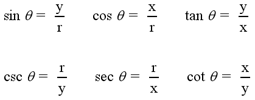 |
| http://calculus.nipissingu.ca/tutorials/trigonometrygifs/oa_table.gif |
2. Show and explain how to derive the two remaining Pythagorean Identities from sin2x+cos2x=1. Be sure to show step by step.
a) In order to derive the identity with secant and tangent, you will have sin^2x + cos^2x = 1(cos^2x). Then if you divide the equation by cos^2x it will look like this, sin^2x/cos^2x + cos^2x/cos^2x = 1(cos^2x)/cos^2x. Once it is simplified you will have
sin^2x/cos^2x +1= 1/cos^2x which could be simplified even more to tan^2x +1 = sec^2x.
sin^2x/cos^2x +1= 1/cos^2x which could be simplified even more to tan^2x +1 = sec^2x.
b) In order to derive the identity with cosecant and cotangent you will have sin^2x + cos^2x = 1 but unlike the other one shown above, we have to divide the whole equation by sin^2x. Then you will end up with 1+ cos^2x/sin^2x = 1/ sin^2x which can be simplified even more into, 1+ cot^2x = csc^2x.
“The connections that I see between Units N, O, P, and Q so far are…” there is still that reference and relationship between all those units, especially the Unit Circle. All the trig functions and the triangles learned tied back together. All the information learned, especially with Pythagorean Theorem, just proves even more that it is a true statement.
“If I had to describe trigonometry in THREE words, they would be…” triangles,trig functions, and it all relates.
Monday, March 17, 2014
WPP #13 & 14: Unit P Concept 6 & 7
This WPP13-14 was made in collaboration with Melissa Arias.
Please visit the other awesome posts on their blog by going here.
Please visit the other awesome posts on their blog by going here.
Create your own Playlist on LessonPaths!
Sunday, March 16, 2014
BQ#1: Unit P Concepts 1 and 4: Law of Sines, Area of an Oblique Triangle, and Derivations
Law of Sines:
What's the formula?

Why do we need such a thing?
- We need the Law of Sines to help us solve for triangles that are not right triangle (that do not have a 90 degree angle). For a normal right triangle it would be simple to solve for them since we could just Pythagorean Theorem( a^2+b^2=c^2) or we could use other simple formulas to find there angles but, with a non-special right triangle we could use the Law of Sines formula presented above.
How do we know it is already derived from things we know?
- If we were to take a scalene triangle, and just draw a line from the top to the base of the triangle we would get two right triangles, shown as following. Once having drawn that, the picture would look familiar because thanks to Sin, Cos, Tan, and their inverses we would be able to solve them. A perfect example would be : sinA=h/c and sinC=h/a.
If you were to set both example ratios equal to each other you will realize that both ratios have "h" in common and if you cancel that you would get a whole different ratio, as show below.
 If you were to take a look at the triangle again, you will see the m<B could form another equation. Another example: sinB=h/c sinC= h/b. If you do the same thing as the previous ratio you notice that they both have h in common as well, so preform the same thing and you will conclude that sinB/b= SinC/c.
Area of an Oblique Triangle:
How is the “area of an oblique” triangle derived?

If you look at the picture shown on the right, you will see an oblique triangle and the height being drawn to it. Then knowing what we saw above, that sinC=h/a, sinA=h/c, and sinB=h/a(c) we can then multiply them so they can equal "h" and once that is done we can use the are of triangle formula know as A=1/2bh. With that being said, we can then substitute the bh for things we know such as sinB, sinC, sinA.
How does it relate to the area formula that you are familiar with?
Well we were familiar that the area of a triangle is A= 1/2 bh, and knowing that we can actually replace the "h" with values such as sinB, sinC, sinA.
- We need the Law of Sines to help us solve for triangles that are not right triangle (that do not have a 90 degree angle). For a normal right triangle it would be simple to solve for them since we could just Pythagorean Theorem( a^2+b^2=c^2) or we could use other simple formulas to find there angles but, with a non-special right triangle we could use the Law of Sines formula presented above.
How do we know it is already derived from things we know?
 |
| http://library.thinkquest.org/C0121962/sincos1.gif |
 |
| http://dradqrf3hyj25.cloudfront.net/thumbnails/Alg2_13_02_0004-diagram_thumb.png |
 |
Area of an Oblique Triangle:
How is the “area of an oblique” triangle derived?
If you look at the picture shown on the right, you will see an oblique triangle and the height being drawn to it. Then knowing what we saw above, that sinC=h/a, sinA=h/c, and sinB=h/a(c) we can then multiply them so they can equal "h" and once that is done we can use the are of triangle formula know as A=1/2bh. With that being said, we can then substitute the bh for things we know such as sinB, sinC, sinA.
How does it relate to the area formula that you are familiar with?
Well we were familiar that the area of a triangle is A= 1/2 bh, and knowing that we can actually replace the "h" with values such as sinB, sinC, sinA.
Wednesday, March 5, 2014
WPP #12: Unit O Concept 10- Solving angle of elevation and depression
Create your own Playlist on LessonPaths!
Subscribe to:
Posts (Atom)