Pages

Friday, February 21, 2014

I/D2: Unit O - How can we derive the patterns for our special right triangles?

INQUIRY ACTIVITY SUMMARY: 
http://www.proprofs.com/flashcards/upload/a3979269.jpg
In the activity I derived a special right triangle know as an equilateral triangle(shown on the right). The goal was to derive a 30-60-90 triangle from and that could be done by bisecting the triangle in half(like in the picture shown below). Thus creating a 30-60-90 triangle.
http://bitmote.com/public/tetrahedron/.halfEquiTriangle3_s.jpg
In the activity, I was given an equilateral triangle with the lengths of 1, which I bisected in half and received 1/2 as the bottom length. So I knew that my hypotenuse was one and my bottom leg was 1/2, and by using Pythagorean Theorem which is a^2 + b^2 = c^2. I used 1/2 as my a value and 1 as my c value because I was looking for b. Check the picture below to see my work process and I got radical 3 over 2 as the value of b. I then distinguished a pattern among the 30-60-90 triangle. I noticed that 1/2 could be viewed as "n" and 1 as "2n" and radical 3 over 2 as "n rad 3". This would work with any numbers because that is the relationship that all the side have.       


http://blog.powerscore.com/Portals/156640/images/satblog-5.jpg
On the other side of the worksheet, I had to do the same thing but with a 45-45-90 triangle that can be derived from a square. The first thing that I did was draw a line across the square, from one 90 degree angle to the other. Like the picture to the left. I was told that my side lengths for the square were 1. I knew that would have to use Pythagorean Theorem again so that I could solve for my hypotenuse. If you see the bottom picture to the left you'll see my work process for the Pythagorean Theorem. As I looked at the triangles I saw there was a pattern. The 1's could be viewed as n and rad 2 could be viewed as n rad 2 because of the relationship the sides have.


1. In the picture on the left, it shows how to derive a 30-60-90 triangle from a equilateral. Make sure to keep note on what I mention about the patterns I used Pythagorean Theorem to find my b value and after i found the patter that 1 could be 2n and 1/2 could be n and rad 3 over 2 could be n rad 3.  This pattern works for any example check out the other picture to see what I mean.


2. In the following picture, I demonstrate how a 45-45-90 triangle can be derived from a square. Since my side lengths are 10 and I basically cut the square diagonally I bisected the 90 degree angles and made them into 45 degree angles. I knew that i had legs with the length of 10, so I used Pythagorean Theorem to help me find the hypotenuse which was 10 rad 2.  If you look at my work i originally got rad 200 but I broke that into 20 and 10, then broke down the 20 into 2 and 10 which gave me 10 rad 2. The pattern for a 45-45-90 triangle is that since the length would be the same length because it originates from a square you can use those values as "n" and the hypotenuse could be n rad 2. This pattern works for every example, Don't believe me ?  Check out the picture below.


HEADING FOR THIS SECTION: INQUIRY ACTIVITY REFLECTION 


        1. “Something I never noticed before about special right triangles is…” they were found in squares such as the 45-45-90. I knew that the 30-60-90 triangle could be found in an equilateral triangle. 


          2. “Being able to derive these patterns myself aids in my learning because…”
          I get a better understanding on where the patterns actually come from instead of just memorizing them. 


I/D #1: Unit N Concept 7: How do SRTs and the UC relate?

Inquiry Activity Summary:      

-In the following activity you will learn the rules of Special Right Triangles and how the rules and points that you learn from the triangles, can be tied back to the Unit Circle. The special triangles are considered "special" because there sides and hypotenuse is what the Unit Circle is made out of. The three special triangles are, 30 degrees, 45 degrees, and 60 degrees.

https://blogger.googleusercontent.com/img/b/R29vZ2xl/AVvXsEgI-XejwVVlrhIrft3u1Srbt4a6MEKSzd0YbGD0oIHHAyeuDBqjUqsQgk2imdYjoRadTfPkAQ6DWKjW9-twnJGEmhQjHbtkVIvaHv2k3cwttL10uNKbr4YPkmljMwH-pOWlS3lz9mt46YVv/s1600/Untitled.png

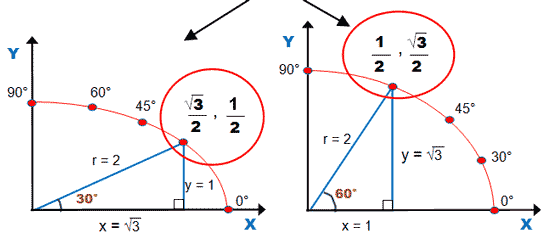
1. The rules for a 30 degree triangle( focus on the picture to the left) are the following:

- the hypotenuse(opposite of 90 degrees) is 2x because
http://dj1hlxw0wr920.cloudfront.net/userfiles/wyzfiles/f8c8bda9-7e7d-47da-b2b6-a36cc369bf07.png
it is 2 times the short side.

- the shortest of the triangle has the value of x.

-the longer side (opposite of the hypotenuse) has the value of radical 3.


2. The rules for a 60 degree triangle (focus on the picture above on the right) are the following

*the same as the 3o degree triangle just flipped

- the hypotenuse(opposite of 90 degrees) is 2x because it is 2 times the short side.

-the shortest of the triangle has the value of x.

- the longer side (opposite of the hypotenuse) has the value of radical 3.


3. The rules for a 45 degree triangle are the following: 
http://dj1hlxw0wr920.cloudfront.net/userfiles/wyzfiles/8b5cdca6-5a42-4ff4-b3df-cabf3e95914e.png

  - the hypotenuse has length x times radical 2

- the sides that make up the 90 degree angle are both the length of x.   


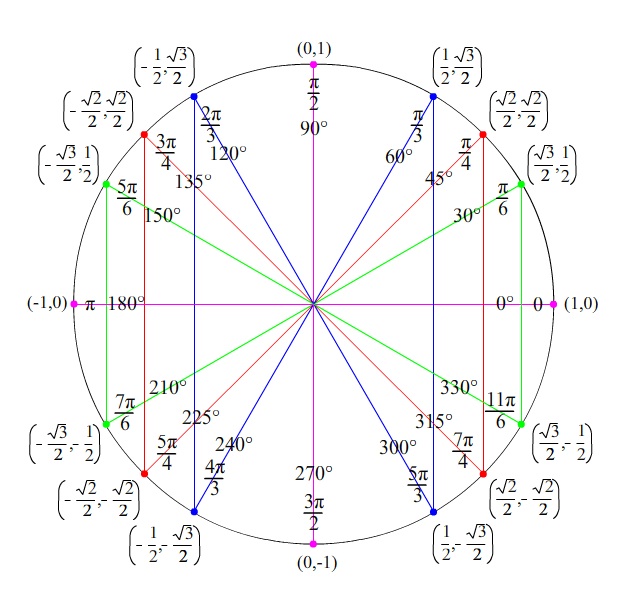
4. This activity made me realize that the special triangles and the unit circle have so many things in common. If you refer back to the picture above, in the red circle there are ordered pairs that reflect back onto the unit circle. The picture below does a great job demonstrating how the unit circle is basically all special triangles. The 03, 45, and 60 degrees on the chart show the order pairs in the unit circle. Really take a look of the unit circle and look at how there is a similarity between each of the quadrants and the logic behind the ordered pairs is the rules that are listed above.
http://www.pccmathuyekawa.com/classes-taught/math_7ab/unit%20circle.jpg


5. As the picture that is show above, all the triangles would apply to all four quadrants. If you flip the triangles in the other three quadrants you would notice a pattern in them. Check out the flowing picture and see what you notice. 
http://01.edu-cdn.com/files/static/learningexpressllc/9781576855966/The_Unit_Circle_34.gif
This picture demonstrates how a 30 degree triangle would look in all the quadrants. Notice that the order pairs do not change, the only things at do are the positive an negative signs that should be easy to understand since in a graph, the second quadrant has a negative x-value but a positive y-value. For the third quadrant both the x and y-value are  negative. Then, in the fourth quadrant, the x-value is positive and the y-value is negative but still the same ordered pairs. See the following example for 60 degree visual.

http://01.edu-cdn.com/files/static/learningexpressllc/9781576855966/The_Unit_Circle_13.gif

  This is a 60 degree  graph and it will be the same concept as the 45 degree one.

https://blogger.googleusercontent.com/img/b/R29vZ2xl/AVvXsEgAeFAQcOzN5WJ1oGL3TBnwK0Qnavf3Jec3LauiNNMLy3Xg8gGR1zEL_f6TSjqpkFO4Y67K-WljPwjTP_bLbfLKGDrCQXKZBuppK7uF87kM0ZHlBWnpmWuhIyqfXsVqWY-8naWmCk5fmSm6/s1600/123.png

 This is a 30 degree one and make sure you do not confuse it with the 60 degree one. Other than that same thing applies to this as the 45 degree example.


Inquiry Activity Reflection:

1.  “The coolest thing I learned from this activity was" the unit circle is basically made up of many special right triangles.

2. “This activity will help me in this unit because…” it really made me realize new tricks and patterns that lie within the unit circle all because of triangles. Knowing the ordered pairs for the triangles is easy it is just knowing whether it is negative depending on the quadrant that it falls on.

3. “Something I never realized before about special right triangles and the unit circle is…” I did not realize that the unit circle is special triangles that you only need to know the first quadrant in order to find the rest of them on the remaining quadrants. 

Monday, February 10, 2014

RWA# 1: Unit M Concept 5: Graphing Ellipses Given Equation

1. The mathematical definition of an ellipse is the set of all points such that the sum of the distance of two points, known as the foci, is a constant.(Unit M WPP)
Description of an Ellipses
     2. Describing an Ellipse
    Algebraically: For an ellipses, the standard formula is (x-h)^2/a + (y-k)^2/b = 1. 
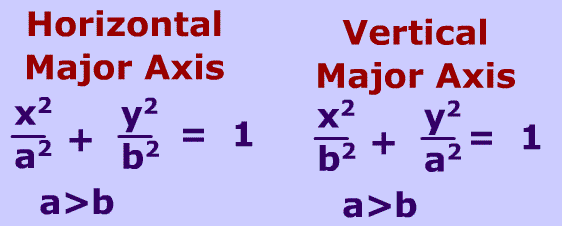
    To solve one of these egg shaped ellipse, you  can quickly figure out the vertex you would take (h, k) only if it is in standard form of course. *An important side note would be the x-value stands for h and the the y-value stands for k. Once you have that done, you can identify the major axis if it is vertical or horizontal. In order to tell if it is horizontal the bigger denominator is under the x^2 term and vise versa for a vertical one.

    The picture below shows you visually how one would be able to distinguish whether one will have a "fat or "skinny" ellipse.
    https://blogger.googleusercontent.com/img/proxy/AVvXsEiF-p9cB7VeWY6ggFmgJ-C5PM4uYUGN7UKG7GuyElsL3JFmNzVG2O7ti0pB5WJet8DfmsQbIt0YdflirUcMC2Qvo06MDNdUysfkADiyje3mkSdT6EaXx3EX15rR27mWz6qD5euMbtltzjNsp8lr7UHx2qNcJvymTFiLOT_gdl2RdgK3Fg=
    Graphically:
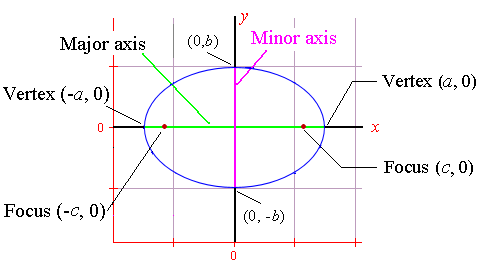
    "The line through the foci intersects the ellipse at two points, the vertices.  The line segment joining the vertices is the major axis, and its midpoint is the center of the ellipse.  The line perpendicular to the major axis at the center intersects the ellipse at two points called the co-vertices (0, ± b).  The line segment that joins these points is the minor axis of the ellipse." (U.G)
    https://blogger.googleusercontent.com/img/proxy/AVvXsEh-MrWwnCslVGn78w0MuvKBc7leqOVXGZDE7BVwVCJG4FnAurAzF7cW1AiuTStCOOlZbn-cIoeQfHBx3MzIJiYOyr78eXyR2ydPnx4g-Y2y6texok8eB7bkT2syZBmUW-3C7QkBYuv6cydCuJRso27xBEwXdsAPFNN7O7GY48Ctj4f5hxUh=
    http://intmstat.com/plane-analytic-geometry/ellipsea.gif
    http://intmstat.com/plane-analytic-geometry/ellipsea.gif


    Key Features:
    The two graphs shown above contain a visual of all the key point of an ellipses. It includes a focus (f)which is c units away from the center. C is the distance from the center to the focus. It also contains a major and a minor axis which are labeled above on the graphs. The major axis is 2a length and the minor axis is 2b lengths. It has co-vertices which is just b units away. "The foci always lie on the major (longest) axis, spaced equally each side of the center. If the major axis and minor axis are the same length, the figure is a circle and both foci are at the center. Reshape the ellipse above and try to create this situation."( http://www.mathopenref.com/ellipsefoci.html) If you want to go in futher detail click here -> http://www.dummies.com/how-to/content/how-to-graph-an-ellipse.html

    Foci and Eccentricity:
    For an ellipses, the foci is normally placed between the vertices of the major axis. he ecccentricity of an ellipse is between 0 and 1 written like the following, 0<e<1. Found a nice website that will help understand the foci and eccentricity a little better by using a visual. http://www.mathopenref.com/ellipseeccentricity.html

    Here's a video that will help you go step by step in solving and ellipses and tell you importants parts of it.


    http://britton.disted.camosun.bc.ca/elliplanet_lg.JPG
    http://britton.disted.camosun.bc.ca/elliplanet_lg.JPG
     Real World Application: A real world application of an ellipses would be some buildings that actually are build like an ellipse if it were seen from a birds eye view. Architects use a center base to serve as the center point of the building.In the picture shown below you see a "skinny" ellipse that has its minor axis going from left to right. Its major axis is going from bottom to top. From the center point of the structure to the co-vertices the value is b.*one thing to keep in mind is that the focus always lies within the major axis. These components are taken into account when building an ellipse shaped structure. Like the following picture. The are used to appear pleasant to the eye. There are also some fins or airfoils that are made like that to cut through the wind. Things that are ellipses are found to have lower gravity in the center.
    4. References:
    • http://jwilson.coe.uga.edu/EMT668/EMAT6680.F99/Erbas/emat6690/Insunit/ellipse/ellipse.html  
    • http://intmstat.com/plane-analytic-geometry/ellipsea.gif
    • http://www.dummies.com/how-to/content/how-to-graph-an-ellipse.html
    • http://www.mathopenref.com/ellipseeccentricity.html
    • http://www.mathopenref.com/ellipseeccentricity.html
    • http://mathforum.org/library/drmath/view/62576.html 
    •  http://britton.disted.camosun.bc.ca/elliplanet_lg.JPG