 |
| http://intmstat.com/different iation/x3.gif |
 |
| http://www.zweigmedia.com/RealWorld/calctopi c1/pics3/pic1.gif |
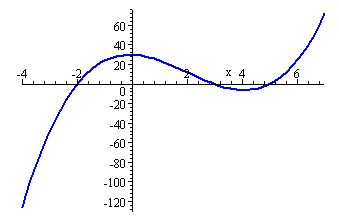
-A discontinuity would obviously be the opposite of a continuous function and it WOULD include breaks, jumps and holes, like the picture of the right. There are four different types of discontinues that consist of two different families such as removable and non-removable discontinuities such as point discontinuity, that IS considered a removable discontinuity because it there was still and intended height that the function had planned. The next three are considered non-removable: jump, oscillating(wiggly), and infinite. Only for the three non-removeable discontinuity, that there limits can NOT be reached because there are different if not not definite limit.** Check question 2 for further information.
 |
| http://ocw.mit.edu/ans 7870/18/18.013a/textbook/Ma thML/chapter06/images/infinite.gif |
 |
| http://www.cwladis.com/math 301/lectu re%20images/infiniteoscillatio ndiscontinuityat1.gif |
 |
| http://ocw.mit.edu/ans7870/18/18.013a/tex tbook/MathML/chapter06/images/infinite.gif |
 |
| http://fitnessandfrozengrapes.com/wp/ wp-content/uploads/2012/10 /the-limit-does-not-exist-mean-girls.jpg |
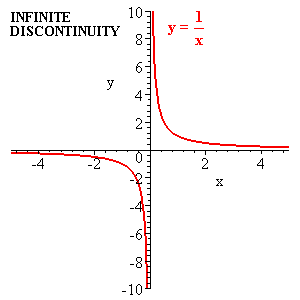
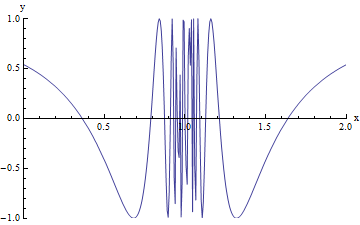
-A limit is the intended height of a function. The only time that the limit exist is when the left and the right direction actually meet at a definite spot. This statement can be seen at point discontinuity (smooth line) because the left and the right side meet which means that the limit and the value are the same. The value is the actual height that a function is able to reach. For a Infinite Discon. there is no limit because of the presence of a vertical asymptote which then leads to unbounded behavior. For a Jump Discon. there is no limit because of different Left and Right. For Oscillating Discon. the limit does not exist because there is no definite height reached.
3. How do we evaluate limits numerically, graphically, and algebraically?
 |
| http://apcalc-kati.weebly.com/uploads/8/6/8/1/8681919/3276816.png |
To evaluate a limit numerically, you take your x-value and you add one tenth to the right and subtract one tenth to the left. For example: if you take a look at the picture to the left, you added 9's to indicate your closeness to the number in the center, which in this case is 1. On the right side you add 0's to indicate the closeness as well. Afterwards you substitute back in your x-values into the equation to get your y-values and lets say that the number to the left are 6.9,6.99,6.99 and on the right its 7.001,7.01,7.1 then we know that the middle number will be 7 because of where the numbers are approaching.
 |
| http://1.bp.blogspot.com/_X1HiqovpZd0/TJidWbCJZyI/AA AAAAAAAmU/L8LU7ZDBHTo/s160 0/LimitsGraphically002.jpg |
-Graphically:
To evaluate limits graphically, you take your index fingers and place on the left and one on the right, and get closer and closer to the x-value that the limit is being asked for. If you fingers actually meet then there IS a limit and if they do NOT then there is not limit because of different left and right, oscillating or unbounded behavior.
-Algebraically:
To evaluate limits algebraically, we always try the substitution method first. The reason being is because it is the easiest method because it can sometimes give you the answer with only having preformed a few simple steps. While using the substitution method we can get a numerical answer like a -5 or 2 or 4. We can also get ) divided by a number and that equals zero. We can also get a number over 0 and that leads to undefined which means that the limit does not exist. We can also get 0 over 0 and that is indeterminate form and we then have to use two other methods, either dividing/factoring or the conjugate. For the dividing/factoring method we would used when we are trying to factor the numerator and the denominator to cancel something out. For more information click here. If the dividing/factoring method does not work, then we would result to the conjugate method which would basically cause us to multiply the fraction by the conjugate of the denominator or numerator, it depends where the radical in the expression is. We would then foil and cancel out the terms that are similar and what is left remaining we would multiply what ever is left and then use direct substitution to finish it off.
