Pages

Monday, April 21, 2014

BQ #5: Unit T Concepts 1-3

Why do sine and cosine NOT have asymptotes, but the other four trig graphs do? Use unit circle ratios to explain.

http://htmartin.myweb.uga.edu/6190/resources/unitcircletrig.gif
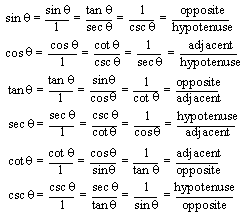
This can be an easy questions to answer if you take a glance at the picture above. *Just make note that the '1' that you see in the picture will be referred to as 'r'. To start off m explanation, r =1 and that's that. The reason why sine and cosine do NOT have asymptotes is because of the r that they have as the denominator. 
Like the picture shows already for sine, the ratio is y over r which is basically y. For cosine the ratio if x over 1 which is basically x. With these ratios for cosine and sine we are guaranteed an answer.
However, for all the other functions, we are not. if we have 1 over 0, now we have undefined which is an asymptote For all the other ratios we will get undefined because if you  have 0 over r (1) for sine and cosine then you will have 0 and that is fine. Having a 0 in the denominator we know that it will be undefined.

Friday, April 18, 2014

BQ#3 – Unit T Concepts 1-3

-How do the graphs of sine and cosine relate to each of the others?  Emphasize asymptotes in your response.

a) Tangent


Tangent is related to sine and cosine because the ratio for tangent is sin over cos. Tan and sin and cos have a relationship where if sin or cos is negative then so will be tan. You can reference my BQ 4 for more information here. In quadrant 1 all of the trig functions are positive. In the 2nd quadrant only sine and cosecant are positive but since cosine is negative, so will tangent. This continues to the rest of the quadrants, so basically to make it simpler, if either sine or cosine are negative then so will tangent.

b) Cotangent  


Sine and Cosine relate to Cotangent basically in the same way that tan does. The ratio for cotangent is cos over sin which then basically means that in order to have asymptotes sin has to equal zero. Sine equals zero at 0 or 2pi. From then on the asymptotes repeat forever and the graph will never be able to cross them. 


c) Secant


Secant can be related back to sine and cosine. The ratio for sec is 1 over cos so what that implies is that cos has to equal zero. Cosine can equal zero when it is at 90 degrees or 270 degrees. If that were to be that case, there would be asymptotes. The secant and cosine relate  because the reciprocal of secant is 1 over cosine which also leads to having cosine equal zero. In a cosine graph, the numbers -1 and 1 show up and if you take a look at the graph, -1 and 1 also show up.


d) Cosecant
  The graph above demonstrates a co-secant possibly relate to sine? Well if you remember something sine you know that it is positive in quadrant 1 and 2. The reciprocal ratio for co-secant is 1 over sine. Something that they have in common is that co-secant touches the mountain tops and the valleys of a sine graph.

Thursday, April 17, 2014

BQ#4 – Unit T Concept 3

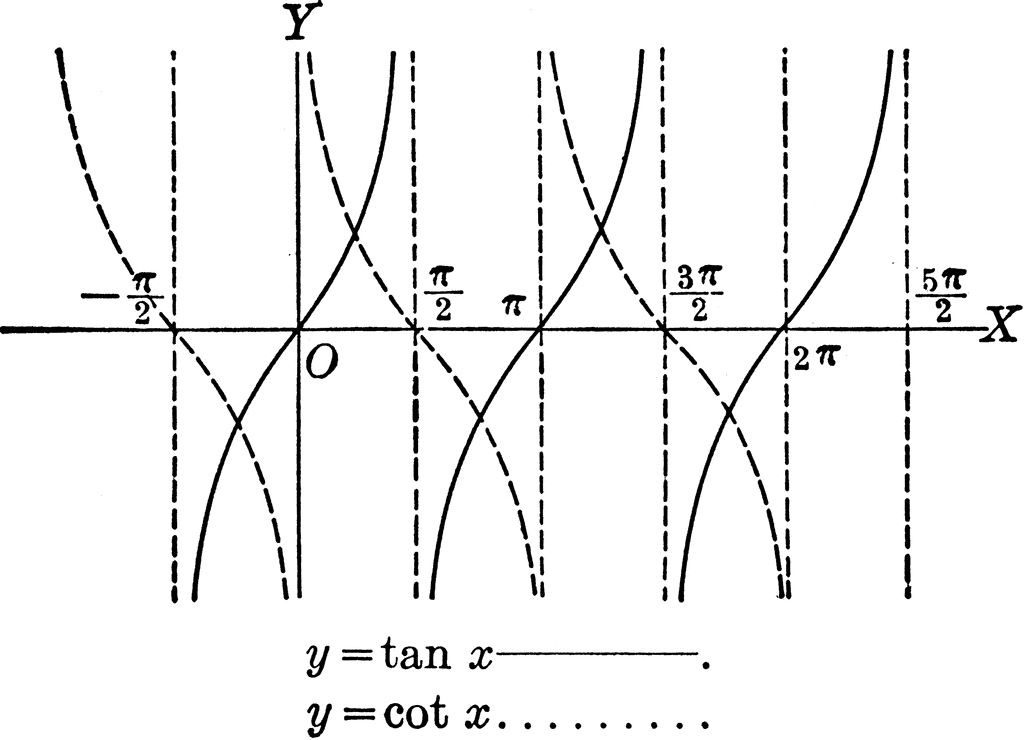
http://etc.usf.edu/clipart/36700/36731/tancotan_36731_lg.gif

http://www.afralisp.net/reference/images/sin-cos06.gif


Why is a "normal" tangent graph uphill, but a "normal" tangent graph downhill? Use unit circle ratios to explain. 
 There are two types of tangent graph, your normal tangent graph that has a ratio of y over x, and your other graph is your cotangent graph that has a ratio of x over y. The only difference why one graph goes up and the other one goes downhill has to do with there asymptotes. So with that being said, you know that for a tangent graph you will have an asymptote where cosine = 0. If you take a look above, you'll see that the ratio for tan is sin over cos. So it makes since to say that a tangent graph will have asymptotes when cos is 0 because cos is in the denominator and if you have a 0 in the denominator you will get 'undefined'. For a cotangent graph it is basically the same thing. The ratio for a cotangent graph is cos over sin and in this case sin has to equal 0

Wednesday, April 16, 2014

BQ#2 – Unit T Concept Intro

*How do the trig graphs relate to the Unit Circle?
 Trigonometric graphs (dealing with sin,cos,tan, and their inverses) can easily be related to the Unit Circle. The graph actually in it of itself has trig graphs.
http://www.regentsprep.org/Regents/math/algtrig/ATT5/unitcirclegraphs.htm


http://www.regentsprep.org/Regents/math/algtrig/ATT5/unitcirclegraphs.htm
The following picture actually demonstrate  how a unit circle were to look if it were to be unwind. The way to know when a graph goes up or continues to go up or down it, it ties back with the saying "All Students Take Calc." For example, if we are dealing with sin, we know that sin is positive in the first and second quadrant, so then, like shown on the top left picture, the lines in quadrant 1 and 2 are positive and in 3 and 4, they are negative. 


Period? - Why is the period for sine and cosine 2pi, whereas the period for tangent and cotangent is pi?  
 If you take a look at the picture shown on the left, if will help with understanding and my explanation to why the period for sine and cosine is 2pi when for tan and cot it is just pi. 
Well if you see the pattern of sin, ++--, and the pattern of cos, +-+-, you notice that that is the end of the pattern. So you know that ++- -or +-+- is the completion of 1 full round around  the unit circle which is also equivalent to 2pi, a whole round around the unit circle. However, with tan and cot it's different. Since there pattern is +-+- their full pattern basically ends at +- because then it starts over with +- again. With that being said, tan and cot only have periods of pi because there complete round, finishes at the pi mark and does not have to go around the unit circle completely.

Amplitude? – How does the fact that sine and cosine have amplitudes of one (and the other trig functions don’t have amplitudes) relate to what we know about the Unit Circle?
Amplitude determines how high a graph might go and how low it will go. A note to remember is that the same high it may have to go up, it will also be the same as that. So for example, is a graph an amplitude of 2 then the highest point on the graph will be 2 and the lowest point will be -2. However, for sine and cosine there amplitude will be 1 and -1 because the graph can only go up one and down one.

Tuesday, April 1, 2014

Reflection#1: Unit Q: Verifying Trig Identities

Hello fellow math analysis Students,
Encountering Unit Q, which deals with ratio identities, reciprocal identities, and Pythagorean identities, might seem overwhelming, I know that for me it did; but if you're like me, fear no more because dealing with this Unit does not have to be scary. I will answer question in hope that this will help you, so enjoy!


What does it actually mean to verify a trig identity?

-To actually "verify a trig identity" it basically means to demonstrate that both side of an equation given to you is equal to one another. The really cool thing about this Unit, is that there is not an actual method that you must preform in order to get it right, as compared to different Unit, where you must do certain steps in a certain order, well anyways, I do not want to get off on a tangent, get it? :) Well just keep in mind that you there are various steps you can take to verify a trig identity.

What tips and tricks have you found helpful?
- My tips and tricks to you is always try to reduce the larger side first and if that is not applicable then just try to have SIN and COS that always works. There are times, that having all the trig functions to one side can help. Another helpful hint is to remember that *Pythagorean Identities CANNOT be "powered up/and or down". I would also advise to make smart choices when using the ratio, reciprocal, and Pythagorean identities.

Explain your thought process and steps you take in verifying a trig identity.  Do not use a specific example, but speak in general terms of what you would do no matter what they give you.
 - My thought process and steps that I take to verify a trig identity is to try to get everything to SIN and COS first. I then try to find if any ratio, reciprocal, and Pythagorean identities would work to help me verify the trig identity. I would try to see if conjugating or finding the LCD or foiling anything would help me.