 |
| http://2.bp.blogspot.com/-C8eIx6cuzZ8/UT1Fd8RhEOI/AAAAAAAAAKc/oh0fvEjF1s4/s640/Identity+Table.png |
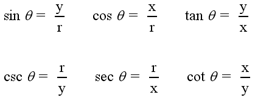
1. Where does where sin2x+cos2x=1 come from to begin with (think Unit Circle!). You should be referring to Unit Circle ratios and the Pythagorean Theorem in your explanation.
- To start off, What is an identity? Well an identity is a proven fact or formula, just like the Pythagorean Theorem. Pythagorean Theorem, a^2+ b^2= c^2, is normally written like that, but another way that it can be written is by using x,y, and r variables, like so: x^2+ y^2= r^2. HOWEVER, if we decided to have the equation equal to 1 instead of r^2 we would have to divide the whole equation by r^2, which eventually would leave to a new equation (x/2)^2 +(y/r)^2= 1.
 |
| http://calculus.nipissingu.ca/tutorials/trigonometrygifs/oa_table.gif |
2. Show and explain how to derive the two remaining Pythagorean Identities from sin2x+cos2x=1. Be sure to show step by step.
a) In order to derive the identity with secant and tangent, you will have sin^2x + cos^2x = 1(cos^2x). Then if you divide the equation by cos^2x it will look like this, sin^2x/cos^2x + cos^2x/cos^2x = 1(cos^2x)/cos^2x. Once it is simplified you will have
sin^2x/cos^2x +1= 1/cos^2x which could be simplified even more to tan^2x +1 = sec^2x.
sin^2x/cos^2x +1= 1/cos^2x which could be simplified even more to tan^2x +1 = sec^2x.
b) In order to derive the identity with cosecant and cotangent you will have sin^2x + cos^2x = 1 but unlike the other one shown above, we have to divide the whole equation by sin^2x. Then you will end up with 1+ cos^2x/sin^2x = 1/ sin^2x which can be simplified even more into, 1+ cot^2x = csc^2x.
“The connections that I see between Units N, O, P, and Q so far are…” there is still that reference and relationship between all those units, especially the Unit Circle. All the trig functions and the triangles learned tied back together. All the information learned, especially with Pythagorean Theorem, just proves even more that it is a true statement.
“If I had to describe trigonometry in THREE words, they would be…” triangles,trig functions, and it all relates.

No comments:
Post a Comment