This SP8 was made in collaboration with Melissa A. This SP8 was made in collaboration with here.
Wednesday, March 26, 2014

Wednesday, March 19, 2014
I/D3: Unit Q: Concept 1 - Pythagorean Identities
 |
| http://2.bp.blogspot.com/-C8eIx6cuzZ8/UT1Fd8RhEOI/AAAAAAAAAKc/oh0fvEjF1s4/s640/Identity+Table.png |
1. Where does where sin2x+cos2x=1 come from to begin with (think Unit Circle!). You should be referring to Unit Circle ratios and the Pythagorean Theorem in your explanation.
- To start off, What is an identity? Well an identity is a proven fact or formula, just like the Pythagorean Theorem. Pythagorean Theorem, a^2+ b^2= c^2, is normally written like that, but another way that it can be written is by using x,y, and r variables, like so: x^2+ y^2= r^2. HOWEVER, if we decided to have the equation equal to 1 instead of r^2 we would have to divide the whole equation by r^2, which eventually would leave to a new equation (x/2)^2 +(y/r)^2= 1.
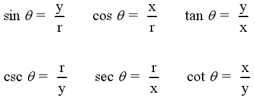 |
| http://calculus.nipissingu.ca/tutorials/trigonometrygifs/oa_table.gif |
2. Show and explain how to derive the two remaining Pythagorean Identities from sin2x+cos2x=1. Be sure to show step by step.
a) In order to derive the identity with secant and tangent, you will have sin^2x + cos^2x = 1(cos^2x). Then if you divide the equation by cos^2x it will look like this, sin^2x/cos^2x + cos^2x/cos^2x = 1(cos^2x)/cos^2x. Once it is simplified you will have
sin^2x/cos^2x +1= 1/cos^2x which could be simplified even more to tan^2x +1 = sec^2x.
b) In order to derive the identity with cosecant and cotangent you will have sin^2x + cos^2x = 1 but unlike the other one shown above, we have to divide the whole equation by sin^2x. Then you will end up with 1+ cos^2x/sin^2x = 1/ sin^2x which can be simplified even more into, 1+ cot^2x = csc^2x.
“The connections that I see between Units N, O, P, and Q so far are…” there is still that reference and relationship between all those units, especially the Unit Circle. All the trig functions and the triangles learned tied back together. All the information learned, especially with Pythagorean Theorem, just proves even more that it is a true statement.
“If I had to describe trigonometry in THREE words, they would be…” triangles,trig functions, and it all relates.
Monday, March 17, 2014
WPP #13 & 14: Unit P Concept 6 & 7
This WPP13-14 was made in collaboration with Melissa Arias.
Please visit the other awesome posts on their blog by going here.
Please visit the other awesome posts on their blog by going here.
Create your own Playlist on LessonPaths!
Sunday, March 16, 2014
BQ#1: Unit P Concepts 1 and 4: Law of Sines, Area of an Oblique Triangle, and Derivations
Law of Sines:
What's the formula?

Why do we need such a thing?
- We need the Law of Sines to help us solve for triangles that are not right triangle (that do not have a 90 degree angle). For a normal right triangle it would be simple to solve for them since we could just Pythagorean Theorem( a^2+b^2=c^2) or we could use other simple formulas to find there angles but, with a non-special right triangle we could use the Law of Sines formula presented above.
How do we know it is already derived from things we know?
- If we were to take a scalene triangle, and just draw a line from the top to the base of the triangle we would get two right triangles, shown as following. Once having drawn that, the picture would look familiar because thanks to Sin, Cos, Tan, and their inverses we would be able to solve them. A perfect example would be : sinA=h/c and sinC=h/a.
If you were to set both example ratios equal to each other you will realize that both ratios have "h" in common and if you cancel that you would get a whole different ratio, as show below.
 If you were to take a look at the triangle again, you will see the m<B could form another equation. Another example: sinB=h/c sinC= h/b. If you do the same thing as the previous ratio you notice that they both have h in common as well, so preform the same thing and you will conclude that sinB/b= SinC/c.
Area of an Oblique Triangle:
How is the “area of an oblique” triangle derived?

If you look at the picture shown on the right, you will see an oblique triangle and the height being drawn to it. Then knowing what we saw above, that sinC=h/a, sinA=h/c, and sinB=h/a(c) we can then multiply them so they can equal "h" and once that is done we can use the are of triangle formula know as A=1/2bh. With that being said, we can then substitute the bh for things we know such as sinB, sinC, sinA.
How does it relate to the area formula that you are familiar with?
Well we were familiar that the area of a triangle is A= 1/2 bh, and knowing that we can actually replace the "h" with values such as sinB, sinC, sinA.
- We need the Law of Sines to help us solve for triangles that are not right triangle (that do not have a 90 degree angle). For a normal right triangle it would be simple to solve for them since we could just Pythagorean Theorem( a^2+b^2=c^2) or we could use other simple formulas to find there angles but, with a non-special right triangle we could use the Law of Sines formula presented above.
How do we know it is already derived from things we know?
 |
| http://library.thinkquest.org/C0121962/sincos1.gif |
 |
| http://dradqrf3hyj25.cloudfront.net/thumbnails/Alg2_13_02_0004-diagram_thumb.png |
 |
Area of an Oblique Triangle:
How is the “area of an oblique” triangle derived?
If you look at the picture shown on the right, you will see an oblique triangle and the height being drawn to it. Then knowing what we saw above, that sinC=h/a, sinA=h/c, and sinB=h/a(c) we can then multiply them so they can equal "h" and once that is done we can use the are of triangle formula know as A=1/2bh. With that being said, we can then substitute the bh for things we know such as sinB, sinC, sinA.
How does it relate to the area formula that you are familiar with?
Well we were familiar that the area of a triangle is A= 1/2 bh, and knowing that we can actually replace the "h" with values such as sinB, sinC, sinA.
Wednesday, March 5, 2014
WPP #12: Unit O Concept 10- Solving angle of elevation and depression
Create your own Playlist on LessonPaths!
Friday, February 21, 2014
I/D2: Unit O - How can we derive the patterns for our special right triangles?
INQUIRY ACTIVITY SUMMARY:
In the activity I derived a special right triangle know as an equilateral triangle(shown on the right). The goal was to derive a 30-60-90 triangle from and that could be done by bisecting the triangle in half(like in the picture shown below). Thus creating a 30-60-90 triangle.
 In the activity, I was given an equilateral triangle with the lengths of 1, which I bisected in half and received 1/2 as the bottom length. So I knew that my hypotenuse was one and my bottom leg was 1/2, and by using Pythagorean Theorem which is a^2 + b^2 = c^2. I used 1/2 as my a value and 1 as my c value because I was looking for b. Check the picture below to see my work process and I got radical 3 over 2 as the value of b. I then distinguished a pattern among the 30-60-90 triangle. I noticed that 1/2 could be viewed as "n" and 1 as "2n" and radical 3 over 2 as "n rad 3". This would work with any numbers because that is the relationship that all the side have.
 On the other side of the worksheet, I had to do the same thing but with a 45-45-90 triangle that can be derived from a square. The first thing that I did was draw a line across the square, from one 90 degree angle to the other. Like the picture to the left. I was told that my side lengths for the square were 1. I knew that would have to use Pythagorean Theorem again so that I could solve for my hypotenuse. If you see the bottom picture to the left you'll see my work process for the Pythagorean Theorem. As I looked at the triangles I saw there was a pattern. The 1's could be viewed as n and rad 2 could be viewed as n rad 2 because of the relationship the sides have.

1. In the picture on the left, it shows how to derive a 30-60-90 triangle from a equilateral. Make sure to keep note on what I mention about the patterns I used Pythagorean Theorem to find my b value and after i found the patter that 1 could be 2n and 1/2 could be n and rad 3 over 2 could be n rad 3. This pattern works for any example check out the other picture to see what I mean.


2. In the following picture, I demonstrate how a 45-45-90 triangle can be derived from a square. Since my side lengths are 10 and I basically cut the square diagonally I bisected the 90 degree angles and made them into 45 degree angles. I knew that i had legs with the length of 10, so I used Pythagorean Theorem to help me find the hypotenuse which was 10 rad 2. If you look at my work i originally got rad 200 but I broke that into 20 and 10, then broke down the 20 into 2 and 10 which gave me 10 rad 2. The pattern for a 45-45-90 triangle is that since the length would be the same length because it originates from a square you can use those values as "n" and the hypotenuse could be n rad 2. This pattern works for every example, Don't believe me ? Check out the picture below.

HEADING FOR THIS SECTION: INQUIRY ACTIVITY REFLECTION
 |
| http://www.proprofs.com/flashcards/upload/a3979269.jpg |
 |
| http://bitmote.com/public/tetrahedron/.halfEquiTriangle3_s.jpg |
In the activity, I was given an equilateral triangle with the lengths of 1, which I bisected in half and received 1/2 as the bottom length. So I knew that my hypotenuse was one and my bottom leg was 1/2, and by using Pythagorean Theorem which is a^2 + b^2 = c^2. I used 1/2 as my a value and 1 as my c value because I was looking for b. Check the picture below to see my work process and I got radical 3 over 2 as the value of b. I then distinguished a pattern among the 30-60-90 triangle. I noticed that 1/2 could be viewed as "n" and 1 as "2n" and radical 3 over 2 as "n rad 3". This would work with any numbers because that is the relationship that all the side have.  |
| http://blog.powerscore.com/Portals/156640/images/satblog-5.jpg |
On the other side of the worksheet, I had to do the same thing but with a 45-45-90 triangle that can be derived from a square. The first thing that I did was draw a line across the square, from one 90 degree angle to the other. Like the picture to the left. I was told that my side lengths for the square were 1. I knew that would have to use Pythagorean Theorem again so that I could solve for my hypotenuse. If you see the bottom picture to the left you'll see my work process for the Pythagorean Theorem. As I looked at the triangles I saw there was a pattern. The 1's could be viewed as n and rad 2 could be viewed as n rad 2 because of the relationship the sides have. 1. In the picture on the left, it shows how to derive a 30-60-90 triangle from a equilateral. Make sure to keep note on what I mention about the patterns I used Pythagorean Theorem to find my b value and after i found the patter that 1 could be 2n and 1/2 could be n and rad 3 over 2 could be n rad 3. This pattern works for any example check out the other picture to see what I mean.
2. In the following picture, I demonstrate how a 45-45-90 triangle can be derived from a square. Since my side lengths are 10 and I basically cut the square diagonally I bisected the 90 degree angles and made them into 45 degree angles. I knew that i had legs with the length of 10, so I used Pythagorean Theorem to help me find the hypotenuse which was 10 rad 2. If you look at my work i originally got rad 200 but I broke that into 20 and 10, then broke down the 20 into 2 and 10 which gave me 10 rad 2. The pattern for a 45-45-90 triangle is that since the length would be the same length because it originates from a square you can use those values as "n" and the hypotenuse could be n rad 2. This pattern works for every example, Don't believe me ? Check out the picture below.
HEADING FOR THIS SECTION: INQUIRY ACTIVITY REFLECTION
- “Something I never noticed before about special right triangles is…” they were found in squares such as the 45-45-90. I knew that the 30-60-90 triangle could be found in an equilateral triangle.2. “Being able to derive these patterns myself aids in my learning because…”I get a better understanding on where the patterns actually come from instead of just memorizing them.
I/D #1: Unit N Concept 7: How do SRTs and the UC relate?
Inquiry Activity Summary:
-In the following activity you will learn the rules of Special Right Triangles and how the rules and points that you learn from the triangles, can be tied back to the Unit Circle. The special triangles are considered "special" because there sides and hypotenuse is what the Unit Circle is made out of. The three special triangles are, 30 degrees, 45 degrees, and 60 degrees.
 |
| https://blogger.googleusercontent.com/img/b/R29vZ2xl/AVvXsEgI-XejwVVlrhIrft3u1Srbt4a6MEKSzd0YbGD0oIHHAyeuDBqjUqsQgk2imdYjoRadTfPkAQ6DWKjW9-twnJGEmhQjHbtkVIvaHv2k3cwttL10uNKbr4YPkmljMwH-pOWlS3lz9mt46YVv/s1600/Untitled.png |
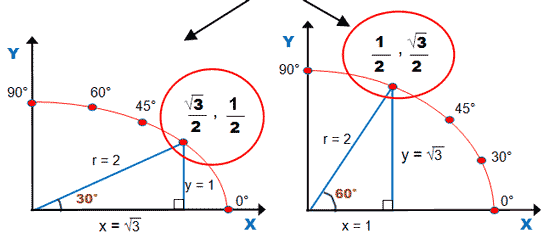
1. The rules for a 30 degree triangle( focus on the picture to the left) are the following:
- the hypotenuse(opposite of 90 degrees) is 2x because
http://dj1hlxw0wr920.cloudfront.net/userfiles/wyzfiles/f8c8bda9-7e7d-47da-b2b6-a36cc369bf07.png
it is 2 times the short side.
- the shortest of the triangle has the value of x.
-the longer side (opposite of the hypotenuse) has the value of radical 3.
2. The rules for a 60 degree triangle (focus on the picture above on the right) are the following
*the same as the 3o degree triangle just flipped
- the hypotenuse(opposite of 90 degrees) is 2x because it is 2 times the short side.
-the shortest of the triangle has the value of x.
- the longer side (opposite of the hypotenuse) has the value of radical 3.
3. The rules for a 45 degree triangle are the following:

http://dj1hlxw0wr920.cloudfront.net/userfiles/wyzfiles/8b5cdca6-5a42-4ff4-b3df-cabf3e95914e.png
- the hypotenuse has length x times radical 2
- the sides that make up the 90 degree angle are both the length of x.
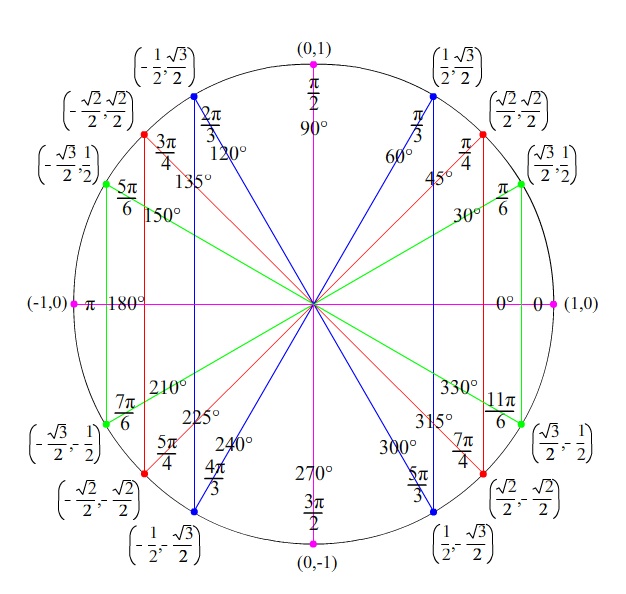
4. This activity made me realize that the special triangles and the unit circle have so many things in common. If you refer back to the picture above, in the red circle there are ordered pairs that reflect back onto the unit circle. The picture below does a great job demonstrating how the unit circle is basically all special triangles. The 03, 45, and 60 degrees on the chart show the order pairs in the unit circle. Really take a look of the unit circle and look at how there is a similarity between each of the quadrants and the logic behind the ordered pairs is the rules that are listed above.
http://www.pccmathuyekawa.com/classes-taught/math_7ab/unit%20circle.jpg
5. As the picture that is show above, all the triangles would apply to all four quadrants. If you flip the triangles in the other three quadrants you would notice a pattern in them. Check out the flowing picture and see what you notice.

http://01.edu-cdn.com/files/static/learningexpressllc/9781576855966/The_Unit_Circle_34.gif
This picture demonstrates how a 30 degree triangle would look in all the quadrants. Notice that the order pairs do not change, the only things at do are the positive an negative signs that should be easy to understand since in a graph, the second quadrant has a negative x-value but a positive y-value. For the third quadrant both the x and y-value are negative. Then, in the fourth quadrant, the x-value is positive and the y-value is negative but still the same ordered pairs. See the following example for 60 degree visual.
 |
| http://01.edu-cdn.com/files/static/learningexpressllc/9781576855966/The_Unit_Circle_13.gif |
This is a 60 degree graph and it will be the same concept as the 45 degree one.
 |
| https://blogger.googleusercontent.com/img/b/R29vZ2xl/AVvXsEgAeFAQcOzN5WJ1oGL3TBnwK0Qnavf3Jec3LauiNNMLy3Xg8gGR1zEL_f6TSjqpkFO4Y67K-WljPwjTP_bLbfLKGDrCQXKZBuppK7uF87kM0ZHlBWnpmWuhIyqfXsVqWY-8naWmCk5fmSm6/s1600/123.png |
This is a 30 degree one and make sure you do not confuse it with the 60 degree one. Other than that same thing applies to this as the 45 degree example.
Inquiry Activity Reflection:
1. “The coolest thing I learned from this activity was" the unit circle is basically made up of many special right triangles.
2. “This activity will help me in this unit because…” it really made me realize new tricks and patterns that lie within the unit circle all because of triangles. Knowing the ordered pairs for the triangles is easy it is just knowing whether it is negative depending on the quadrant that it falls on.
3. “Something I never realized before about special right triangles and the unit circle is…” I did not realize that the unit circle is special triangles that you only need to know the first quadrant in order to find the rest of them on the remaining quadrants.
Subscribe to:
Posts (Atom)