Pages

Monday, February 10, 2014

RWA# 1: Unit M Concept 5: Graphing Ellipses Given Equation

1. The mathematical definition of an ellipse is the set of all points such that the sum of the distance of two points, known as the foci, is a constant.(Unit M WPP)
Description of an Ellipses
     2. Describing an Ellipse
    Algebraically: For an ellipses, the standard formula is (x-h)^2/a + (y-k)^2/b = 1. 
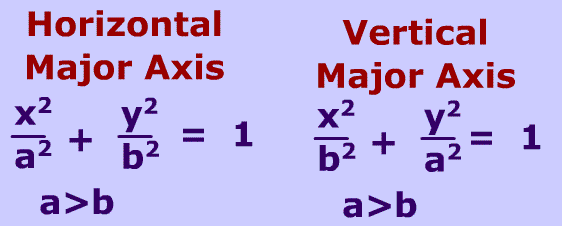
    To solve one of these egg shaped ellipse, you  can quickly figure out the vertex you would take (h, k) only if it is in standard form of course. *An important side note would be the x-value stands for h and the the y-value stands for k. Once you have that done, you can identify the major axis if it is vertical or horizontal. In order to tell if it is horizontal the bigger denominator is under the x^2 term and vise versa for a vertical one.

    The picture below shows you visually how one would be able to distinguish whether one will have a "fat or "skinny" ellipse.
    https://blogger.googleusercontent.com/img/proxy/AVvXsEiF-p9cB7VeWY6ggFmgJ-C5PM4uYUGN7UKG7GuyElsL3JFmNzVG2O7ti0pB5WJet8DfmsQbIt0YdflirUcMC2Qvo06MDNdUysfkADiyje3mkSdT6EaXx3EX15rR27mWz6qD5euMbtltzjNsp8lr7UHx2qNcJvymTFiLOT_gdl2RdgK3Fg=
    Graphically:
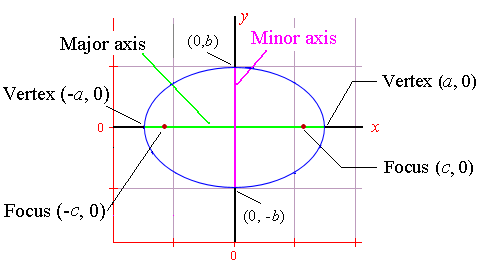
    "The line through the foci intersects the ellipse at two points, the vertices.  The line segment joining the vertices is the major axis, and its midpoint is the center of the ellipse.  The line perpendicular to the major axis at the center intersects the ellipse at two points called the co-vertices (0, ± b).  The line segment that joins these points is the minor axis of the ellipse." (U.G)
    https://blogger.googleusercontent.com/img/proxy/AVvXsEh-MrWwnCslVGn78w0MuvKBc7leqOVXGZDE7BVwVCJG4FnAurAzF7cW1AiuTStCOOlZbn-cIoeQfHBx3MzIJiYOyr78eXyR2ydPnx4g-Y2y6texok8eB7bkT2syZBmUW-3C7QkBYuv6cydCuJRso27xBEwXdsAPFNN7O7GY48Ctj4f5hxUh=
    http://intmstat.com/plane-analytic-geometry/ellipsea.gif
    http://intmstat.com/plane-analytic-geometry/ellipsea.gif


    Key Features:
    The two graphs shown above contain a visual of all the key point of an ellipses. It includes a focus (f)which is c units away from the center. C is the distance from the center to the focus. It also contains a major and a minor axis which are labeled above on the graphs. The major axis is 2a length and the minor axis is 2b lengths. It has co-vertices which is just b units away. "The foci always lie on the major (longest) axis, spaced equally each side of the center. If the major axis and minor axis are the same length, the figure is a circle and both foci are at the center. Reshape the ellipse above and try to create this situation."( http://www.mathopenref.com/ellipsefoci.html) If you want to go in futher detail click here -> http://www.dummies.com/how-to/content/how-to-graph-an-ellipse.html

    Foci and Eccentricity:
    For an ellipses, the foci is normally placed between the vertices of the major axis. he ecccentricity of an ellipse is between 0 and 1 written like the following, 0<e<1. Found a nice website that will help understand the foci and eccentricity a little better by using a visual. http://www.mathopenref.com/ellipseeccentricity.html

    Here's a video that will help you go step by step in solving and ellipses and tell you importants parts of it.


    http://britton.disted.camosun.bc.ca/elliplanet_lg.JPG
    http://britton.disted.camosun.bc.ca/elliplanet_lg.JPG
     Real World Application: A real world application of an ellipses would be some buildings that actually are build like an ellipse if it were seen from a birds eye view. Architects use a center base to serve as the center point of the building.In the picture shown below you see a "skinny" ellipse that has its minor axis going from left to right. Its major axis is going from bottom to top. From the center point of the structure to the co-vertices the value is b.*one thing to keep in mind is that the focus always lies within the major axis. These components are taken into account when building an ellipse shaped structure. Like the following picture. The are used to appear pleasant to the eye. There are also some fins or airfoils that are made like that to cut through the wind. Things that are ellipses are found to have lower gravity in the center.
    4. References:
    • http://jwilson.coe.uga.edu/EMT668/EMAT6680.F99/Erbas/emat6690/Insunit/ellipse/ellipse.html  
    • http://intmstat.com/plane-analytic-geometry/ellipsea.gif
    • http://www.dummies.com/how-to/content/how-to-graph-an-ellipse.html
    • http://www.mathopenref.com/ellipseeccentricity.html
    • http://www.mathopenref.com/ellipseeccentricity.html
    • http://mathforum.org/library/drmath/view/62576.html 
    •  http://britton.disted.camosun.bc.ca/elliplanet_lg.JPG

    Monday, December 9, 2013

    SP #6: Unit K Concept 10 - Writing repeating number as rational number using geometric series


     Make sure to pay special attention to see if the number continues on forever. The process of infinite series must be used. All your work must be shown, meaning a calculator cannot be used to get you the answer, you can ONLY use it to check your work like shown on picture #2. If it has a number at the beginning of the problem next to the decimal, you must remember to add it to the sum.If you end with the number you started then you did it correct.

    Friday, November 29, 2013

    Fibonacci Beauty Ratio

    Measurements of Friends:


    Katie Wong:
    Foot to Navel: 102cm
    Navel to top of Head: 62cm
    Ratio: 102/62=1.65
    Navel to chin: 46cm
    chin to top of head: 18cm
    Ratio: 46/18=2.56cm
    Knee to navel: 57cm
    Foot to knee: 46cm
    Ratio: 57/46=1.24cm
    AVERAGE:  1.82cm

    Daisy Larco:
    Foot to Navel: 96cm
    Navel to top of Head: 64cm 
    Ratio: 96/64=1.65cm
    Navel to chin: 45cm
    chin to top of head: 19cm
    Ratio: 45/19=2.31cm
    Knee to navel: 57cm
    Foot to knee: 46cm
    Ratio: 57/46=1.24cm
    AVERAGE: 1.73cm

    Melissa Arias:
    Foot to Navel: 104cm
    Navel to top of Head: 65cm 
    Ratio: 104/65=1.6cm
    Navel to chin: 45cm
    chin to top of head: 21cm
    Ratio: 45/21=2.14
    Knee to navel: 54cm
    Foot to knee: 47cm
    Ratio: 54/47=1.14cm
    AVERAGE: 1.63

    Mrs. Kirch:
    Foot to Navel: 105cm
    Navel to top of Head:68cm 
    Ratio: 105/68=1.54cm
    Navel to chin: 49cm
    chin to top of head: 20cm
    Ratio: 49/20=2.45
    Knee to navel: 54cm
    Foot to knee: 48cm
    Ratio: 54/48=1.13cm
    AVERAGE:1.71cm 

    Vanessa Ceja:
    Foot to Navel: 99cm
    Navel to top of Head: 63cm 
    Ratio: 99/63=1.57cm
    Navel to chin: 44cm
    chin to top of head: 21cm
    Ratio: 44/21=2.09
    Knee to navel: 55cm
    Foot to knee: 45cm
    Ratio: 55/45=1.22cm
    AVERAGE: 1.63cm

    According to the Beauty Ratio, Melissa and Vanessa are the ones that are beautiful according to the "Golden Ratio" of 1.168 they were the closest with both having the average of 1.63cm. I think that the Golden Ration cannot determine whether or not someone is beautiful. I personally think that proportion has nothing to do with beauty. The determining factors that do determine beauty is someones personality and charisma.

    Sunday, November 24, 2013

    Fibonacci Haiku: The Hungry Fear

    Thanksgiving.
    Food.
    Always eating
    Can't get enough.
    Stretch pant feel really tight.
    Turkeys really dread when I walk on by.

    Sunday, November 17, 2013

    SP#6 Unit J Concept 6


    In this SP, I show you how to do Partial Fraction Decomposition with distinct factors. You have to keep in mind while solving that you you have to separate each fraction into separate fractions by putting letter like A,B,C on top. Then find the least common denominator for the fractions and multiply the missing part. Then group all the terms together and set them equal to the coefficients of the numerator and solve for the equations and put back A,B,C where they belong. The addition with this problem is that since the factors repeat you have to count up to the powers.